
*For a list of all the articles in this series and other political articles, please go here: https://cityuntangled.com/category/politics/.
Residents of Northampton, MA have been having much discussion about whether the City has too much surplus revenue it could be using for the operating budget. It is a valid policy discussion where different approaches have different tradeoffs. One issue is that some who are criticizing the current administration’s approach has some misunderstanding of the details.
Ward 5 City Councilor Alex Jarrett (https://alexjarrett.com/) wrote a response to a letter by Deb Henson who is running for City Councilor-At-Large (https://vote4debhenson.com/). A neighbor shared the Google Docs link on our neighborhood listserv, and I am sharing it here, https://docs.google.com/document/d/19g84E4roioJtv2GTDOLLyqaxLm92xgNF31tQWIYdHR4/edit?tab=t.0, with Councilor Jarrett’s permission. You can download a PDF version of it from this blog in case you run into issues with the Google document:
My Response on our Neighborhood Listserv
[On October 1, 2025, a neighbor who is an acquaintance of Deb Henson shared Deb Henson’s said letter on our neighborhood listserv. The following is my long response the next day regarding Deb Henson’s first sentence, “Northampton is #8 in the entire state for cash reserves in hand?” It is my feeble attempt to clarify a very complex topic. I added some formatting for readability.]
Hi,
Long post here to be thorough. I will move on after this. It would be most appropriate if you contact public officials I list below. If you really want to talk to me, like I always suggest, we can meet in-person or over Zoom if you are uncomfortable.
Would [Redacted name of the acquaintance] and Deb Henson cite their sources about the claim, “Northampton is #8 in the entire state for cash reserves in hand?” This idea was largely debunked via Mayor Sciarra’s Gazette column and a January public meeting. The basic idea from my understanding is that while the cash reserves amounts are similar for many municipalities, not every municipality moves enterprise fund (water, sewer, solid waste, stormwater) free cash into a dedicated specialized enterprise stabilization fund. They retain it in the enterprise fund, which while administratively simpler, does not generate interest and can result in less financial discipline from my understanding. When municipalities report stabilization funds to the State government, this makes Northampton looks like it has much higher stabilization funds than other municipalities, which I think is a weakness in the reporting system and also the MA Home Rule system which do not have a uniform set of practices for municipalities. They result in complex differences that are hard to follow.
You can dispute those ideas, but everyone can benefit from you stating more specific ideas and citing sources. Also, you might want to cross-check your ideas with government officials whose purview is finance. If you go here, https://www.northamptonma.gov/2356/Budgets, the Finance Director’s contact info is listed to the right. While you might not get an immediate response, it would probably be helpful to verify your ideas. Also, while finance is not his direct purview, Ward 5 councilor Alex Jarrett is very knowledgeable. His contact info is at the “Contact Your Councilor” section at https://www.northamptonma.gov/2570/City-Council.
Below are my sources and details. I list several to try to be thorough. Again, I am not an expert. Please contact the appropriate public officials to verify:
1. The Mayor’s 1/14/2025 column at https://gazettenet.com/2025/01/14/guest-columnist-sciarra-58893103/. Bold highlights added by me. She writes:
“The fourth misconception is that the city is hoarding money in stabilization funds. This argument is based on a table provided by the state [https://dlsgateway.dor.state.ma.us/reports/rdPage.aspx?rdReport=Dashboard.Cat_1_Reports.StablPerBudget351] that ostensibly allows people to compare what each municipality has in stabilization funds relative to its operating budget.
For FY24, out of 207 municipalities with reported amounts, Northampton’s $35.8 million ranks sixth. As a percent of the operating budget, Northampton’s 27.3% ranks 12th. Few cities crack 20%.
That appears excessive. But unclear in the table is that Northampton’s amount includes $16.5 million from enterprise stabilization funds. These support our Water, Sewer, Solid Waste, and Stormwater enterprise funds.
Enterprise funds are closed systems maintained by utility fees, which cannot be redirected to schools. Furthermore, not every municipality has enterprise stabilization funds. Comparing Northampton’s total to other cities is not apples-to-apples.
For example, Amherst and Easthampton do not have enterprise stabilization funds. If you remove Northampton’s enterprise stabilization funds and then compare each municipality’s FY24 percentages relative to their budgets, Northampton’s 14.74% is lower than Amherst’s 17.99% and Easthampton’s 15.25%.“
2. If you open the “Mayor’s FY2026 Financial Trends and Projections for the Fiscal Year 2025 Budget Process (PDF)” at https://www.northamptonma.gov/2356/Budgets, slide 66 shows the comparison of stabilization funds across municipalities with Northampton Enterprise stabilization funds removed.
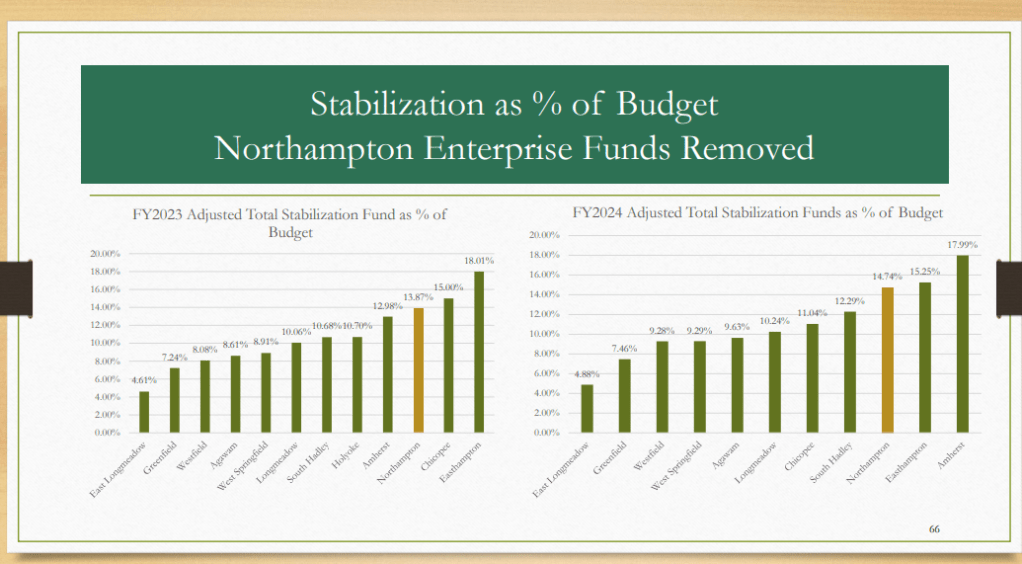
3. The 1/30/2025 presentation on YouTube of the above slide. It’s at 1:12:03, https://youtu.be/2KkfSE9YzVE?t=4323.
4. The last sentence of the State’s Free Cash guidance (https://www.mass.gov/doc/the-importance-of-free-cash/download): “The same rules apply to DLS’s certification of retained earnings, which is the enterprise fund equivalent of free cash.” Retained earnings is the common term for free cash, i.e. surplus cash, from enterprise funds.
5. Enterprise Fund Retained Earnings as % of Total Enterprise Fund table from the Division of Local Services under the MA Department of Revenue at https://dls-gw.dor.state.ma.us/reports/rdPage.aspx?rdReport=Dashboard.Cat_1_Reports.RetainedEarningsPerBud351. While this is not an absolute proof since I don’t fully understand it, you will notice that other nearby municipalities have much higher percentages than Northampton for most years. During the past five years, Northampton’s maximum percentage was 32.36% while Amherst, 39.33% and Easthampton, 52.08%. Hadley had a whopping max of 91.8%, which might be some kind of error. Screenshot below.

6. State’s guide, “Enterprise Funds: A Best Practice ” (https://www.mass.gov/doc/best-practices-of-enterprise-funds-mcwt/download) If you go to Page 5, it states, “Considering the establishment of a special purpose stabilization fund (See IGR 08-101)” under a best practice list. So it is recommended but not required.
I want to end with reminding everyone that not everything is a conspiracy and criticisms need to go two ways. As much as we should question others, we also need to question our own biases and errors, which are largely driven by our own privileges and experiences. Besides rising income and wealth inequality, one issue facing nations is the rise in complexity. This has been discussed by academics since at least the 1980s. I cover it in my blog, https://cityuntangled.com/category/complexity/. Thank you.
 City Untangled